
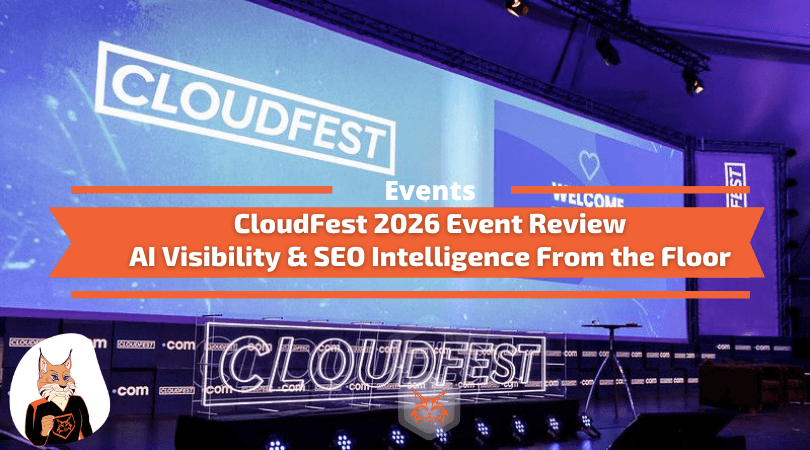
I’m writing this two days after landing back in Bucharest. Not the event highlights everyone will publish, but the specific intelligence, positioning shifts, and market signals that matter to anyone operating in SEO, Competitive Intelligence, and AI Visibility in 2026.
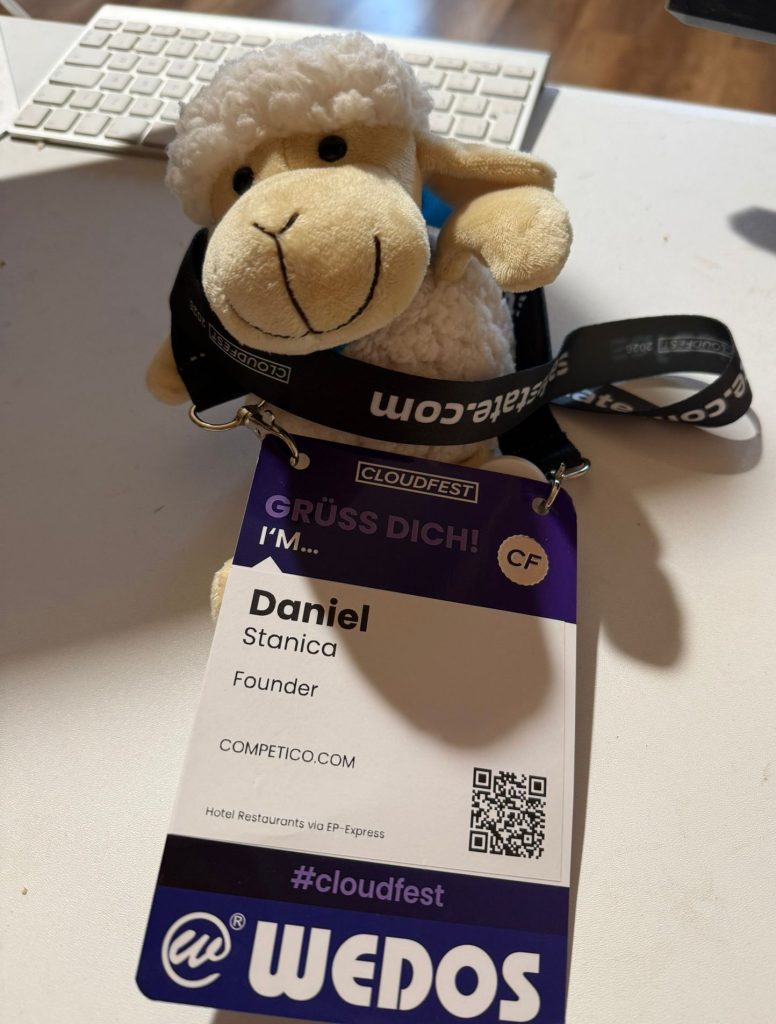
This was my second CloudFest. In 2025, I attended as a media partner from MonetizeBetter. This year, I attended as the CEO of Competico, walking in as a delegate and strategic advisor, pitching AI Visibility audits and partnership solutions across four days of back-to-back meetings with hosting CEOs, cloud founders, SaaS infrastructure leaders, and domain operators.
⚡ Key Takeaways — CloudFest 2026 for SEO & AI Visibility Professionals
- AI Visibility demand has matured. Hosting providers at CloudFest 2026 raised LLM citations and AI search presence unprompted, indicating the market has moved from education to buying mode.
- Generative Engine Optimization (GEO) is now a distinct profession. Traditional SEO optimizes for clicks. GEO optimizes for citations. Treating them as the same problem is costing brands a measurable Share of Model.
- NIS2 compliance has become a first-filter sales qualifier in enterprise infrastructure deals and a commercial-intent SEO cluster that most European hosting providers have yet to capture.
- AI-generated code is producing a new class of technical SEO errors, such as schema hallucinations, canonicalization drift, and hreflang failures, that are not yet covered by standard audit frameworks.
- The topical authority race has reached the infrastructure stage. Major hosting providers are building editorial operations explicitly designed to target AI search visibility. The quality bar for content has risen significantly since mid-2025.
I invite you to read my intelligence brief further, structured around the competitive signals that consistently surfaced on the CloudFest floor and the specific SEO implications that most post-event coverage will miss.
Why CloudFest Matters
Most people in our space frame CloudFest see it as only a hosting and infrastructure event. However, the 10,000+ professionals in those rooms are the ones who build, buy, and operate the infrastructure that powers websites and apps people use every day. They decide which hosting stacks get recommended to millions of SMBs. They set the defaults for managed WordPress environments. Also, they negotiate partnerships that determine which tools get distributed at scale.
For anyone working in SEO advisory, competitive intelligence, or digital marketing consulting, this is the upstream layer of almost everything we work with downstream.
Consider the connection of infrastructure with SEO and AI Visibility:
- Infrastructure decisions at CloudFest determine Core Web Vitals baselines for millions of sites.
- Hosting partnership agreements shape which page builders, caching plugins, and CDN configurations become default for agencies and their clients.
- The compliance frameworks being debated at CloudFest (NIS2, data sovereignty, sovereign AI) are already generating new commercial-intent search clusters that represent the next wave of organic and AI search opportunity for hosting and SaaS providers.
- The brands gaining visibility in AI-generated answers to infrastructure queries are the ones dominating floor conversations at CloudFest right now.
If your competitive intelligence practice does not include signals from the infrastructure layer, your picture of the market has a structural gap.
The AI Visibility Inflection
The most commercially significant shift I observed at CloudFest 2026 was a pattern that repeated across every floor conversation I had over four days.
Last year, AI Visibility was something I had to define before I could open the conversation to sell it. People found it interesting, but had not budgeted for it. At CloudFest 2026, hosting providers and infrastructure companies were raising it themselves, unprompted. The question has shifted from “what is this?” to “who can help us with this, and how fast can we move?”
That is the inflection point. When buyers arrive with the problem pre-formed, the market for a solution has matured.
Here’s what was causing that change on the floor:
- Hosting providers are monitoring their AI citation share. Several mid-sized European providers told me they have started tracking how often their brand appears in ChatGPT, Perplexity, and Gemini responses when users ask for hosting recommendations. Most are not happy with what they find and are actively seeking frameworks to improve it.
- “Do I rank on Google?” is being joined by “Do I exist in AI-powered searches?” These are different questions with different mechanics, different measurement frameworks (Share of Model vs. keyword rank), and different remediation strategies. Providers who conflate them are making expensive mistakes.
- AI Visibility is becoming a B2B sales differentiator. Agency operators at the event told me they are now including AI presence audits as part of new-client onboarding for hosting and SaaS accounts — driven by clients noticing drops in referral traffic from AI-assisted search.
- The March 2026 Google Core Update hardened this shift. The update specifically targeted scaled AI-generated content without human expertise layered on top. Sites with original, first-hand experience and proprietary data gained visibility. This directly rewards the kind of practitioner-written, experience-anchored content that also performs best for AI citations.
For SEO professionals: the brands that establish methodology and documented frameworks in AI Visibility now will define what “good” looks like when enterprise buyers start issuing formal RFPs for GEO services. That window is open, but not indefinitely. AI search adoption is approaching 1 billion users and AI-referred sessions jumped 527% year-over-year in the first five months of 2025 (Previsible). The demand curve is steep and accelerating.
What CloudFest Reveals About the SEO Landscape
1. The Hosting Layer Is an SEO Variable You Are Probably Not Tracking
Core Web Vitals made hosting performance an SEO concern in 2021. But the conversation at CloudFest 2026 has moved well beyond performance metrics.
Edge infrastructure decisions, CDN topology, server-side rendering at the edge, and AI-accelerated content delivery are now influencing crawl behavior, rendering fidelity, and Core Web Vitals in ways that traditional hosting audits do not capture. Specifically:
- Edge-rendered JavaScript is changing how Googlebot sees page content — and the default configurations of new edge platforms are not always crawler-friendly out of the box
- AI-accelerated CDN caching is producing stale content delivery in some configurations, creating indexability gaps between what users see and what crawlers cache.
- Server-side AI processing latency (for AI-generated content layers) is adding TTFB overhead that is beginning to appear in Core Web Vitals data for early adopters.
For technical SEO practitioners: if your audit process does not include an infrastructure layer review focusing on CDN configuration, edge caching rules, rendering pipeline, and server-side AI processing latency, you are missing variables that are already affecting clients’ rankings in competitive verticals.
2. The March 2026 Google Core Update Validated the AI Visibility Thesis
The March 2026 Core Update targeted what Google calls “scaled content abuse” — AI-generated pages without genuine human expertise. The update’s winners were sites with original research, proprietary data, and clearly credentialed authors. The losers were sites with AI-generated volume content and no authentic first-hand experience layer.
This directly validates the GEO optimization premise: the signals Google now rewards most heavily are the same signals LLMs use to determine citation-worthiness. Named expert authors, original data, first-hand experience, and external validation. The two optimization problems: ranking in Google and being cited in AI answers are converging on the same set of content-quality inputs, even though their measurement frameworks remain distinct.
CloudFest 2025 vs. 2026 Comparison
Having attended both editions, the contrast in how AI Visibility and SEO were discussed on the floor is worth documenting clearly for anyone tracking this market.
| Dimension | CloudFest 2025 | CloudFest 2026 |
|---|---|---|
| AI Visibility / GEO | Had to be explained; no budget allocated | Raised unprompted by buyers; active procurement conversations |
| NIS2 in the sales process | Legal and compliance team concern | First-five-minutes qualifier in enterprise deals |
| Data sovereignty SEO intent | Informational search intent | Commercial and transactional intent with growing volume |
| LLM citation tracking | Experimental / no standard tooling | Active SoM tracking; dedicated tools adopted (Scrunch AI, Peec AI, Profound) |
| AI and content creation | Conceptual: “AI will change content.” | Operational risk: AI code generating technical SEO errors at scale |
| Sovereign/private AI hosting | Side conversations; no case studies | Centre stage with production deployments and enterprise contracts |
| Hosting provider content strategy | Product and feature-led content | Editorial operations explicitly targeting AI search citations |
| European cloud narrative | Aspiration backed by regulatory pressure | Execution: deals being won on documentation quality alone |
What was theoretical in 2025 is operational in 2026. The brands that moved early on AI Visibility, GEO investment, and compliance-led content strategy are now in a compounding position. The gap between movers and followers is measurable in Share of Model and in the enterprise deal pipeline.
SEO and AI Visibility Exhibitors
The Siinda Alliance Pavilion: The Most Significant SEO Signal on the Floor
The single most telling exhibitor development for SEO and digital marketing professionals at CloudFest 2026 was not a company, but a pavilion.
Siinda — the leading European non-profit association for digital marketing, local search, and SMB technology — ran a dedicated Alliance Pavilion at CloudFest 2026, bringing together Duda, Uberall, and Spotzer Digital under one roof inside the world’s largest hosting and cloud event. Siinda’s 2026 research programme has moved sharply toward AI search implications for local businesses.
If you advise SMB clients, the default toolset their hosting provider ships to them is being redefined right now, in rooms like this one.
DomainCrawler — Domain Intelligence and Competitive Research
DomainCrawler provides domain intelligence data — a comprehensive crawling and analytics platform that covers domain registration patterns, hosting-provider relationships, DNS configurations, registrar data, and web technology stacks at scale. Its primary users are domain registrars, hosting companies, and market intelligence teams who need portfolio-level insight across millions of domains simultaneously. For competitive intelligence practitioners, DomainCrawler represents a data source that is almost absent from standard SEO toolsets.
Uberall — Local Presence Management in the Hosting Channel
Uberall is a digital presence management platform helping manage business listings, local SEO signals, and brand consistency across Google, social platforms, directories, and AI search surfaces simultaneously. Its presence in the Siinda pavilion at CloudFest 2026 is a direct signal that local presence management is being repositioned as a bundled hosting-channel upsell, not a standalone agency product.
For AI Visibility practitioners specifically, Uberall’s current product direction is worth tracking closely. Consistent NAP (Name, Address, Phone) data and listing accuracy across 40+ directories is one of the highest-leverage inputs for local entity clarity in LLMs
MarketGoo — AI Search Visibility Copilot for Hosting Providers
MarketGoo is the white-label SEO platform specifically engineered for large-scale resale through web hosts, domain registrars, and agencies. Where rankingCoach targets the SMB end-user directly, MarketGoo is built primarily as a provider-side product — giving hosting companies a turnkey, API-integrated SEO tool they can bundle into their plans under their own brand.
BrandForge — AI Brand Content Generation
BrandForge was a Startup Alley participant at CloudFest 2026. While specific product details were limited on the floor, the brand name and positioning signal a focus on AI-assisted brand content creation — the kind of tooling that generates brand narratives, bio copy, and positioning content at scale for the SMB web.
This is relevant to AI Visibility for a specific reason: brand consistency across the web is a foundational GEO signal. AI-generated brand copy that is inconsistent in terminology, positioning, or factual claims across the website, Google Business Profile, directory listings, and social profiles creates entity ambiguity, reducing LLM citation confidence.
Geogen – Platform that bridges the gap between SEO and AI
Geogen is the premier Generative Engine Optimization (GEO) platform designed to bridge the gap between traditional search and the age of AI. As user behavior shifts from scrolling through links to engaging with “Answer Engines,” Geogen provides the data-driven infrastructure brands need to stay visible, cited, and recommended by the world’s leading Large Language Models (LLMs).
The Strategic Value of In-Person Intelligence
I want to close by noting that most of the signals I described above were not in any session, press release, or published recap. They were in conversations on the expo floor, over dinner, and in hotel lobbies at 10 PM after the official event sessions had long ended.
CloudFest brings together decision-makers from the internet infrastructure industry in a single location for four days, in a setting that strips away the formality that makes most conference conversations surface-only.
Real positioning decisions get made between sessions. That is not a marketing cliché about the event. It is the mechanism by which it generates disproportionate intelligence value.
For SEO, CI, and digital marketing professionals, the intelligence available at CloudFest is qualitatively different from anything a tool or crawler can surface. It is forward-looking intent intelligence:
- What hosting providers are planning to invest in over the next 12 months,
- Where enterprise buyers are shifting their procurement criteria,
- Which compliance narratives are gaining commercial traction, and
- Which content categories are transitioning from informational to purchase-stage intent?
You cannot get that from a dashboard or from a keyword tool. You can only get it from the room.
The brands and advisors who will set the standard in AI Visibility, sovereign infrastructure content, and technical SEO for the hosting vertical in 2027 are the ones building relationships and collecting floor intelligence now — not the ones waiting for the published trend reports.
CloudFest 2027 will be held March 15–18 at Europa-Park in Germany. If you are operating in SEO, competitive intelligence, or AI Visibility advisory and want to compare notes before then — or want to benchmark your brand’s current AI citation position with a Competico AI Visibility Audit — get in touch here.
Frequently Asked Questions
What is AI Visibility, and how is it different from traditional SEO?
AI Visibility — also called Generative Engine Optimization (GEO) — is the practice of optimizing your brand and content to appear in AI-generated answers from ChatGPT, Perplexity, Google AI Overviews, and Gemini.
Traditional SEO optimizes for ranked links; AI Visibility optimizes for citations inside AI-synthesized responses. The key difference is the conversion event: in traditional SEO, it is a click, in GEO, it is a citation. AI search visitors convert at 4.4x the rate of traditional search visitors (Semrush, 2026). Still, they may never visit your website at all — making citation share, not rank position, the metric that matters most.
What is Share of Model, and how do you measure it?
Share of Model (SoM) is the primary KPI for GEO. It measures how often your brand appears in AI-generated responses compared to competitors for a defined set of relevant queries.
You measure it by submitting a standardized query set to AI platforms (ChatGPT, Perplexity, Gemini, Google AI Mode) and tracking citation frequency. Tools such as Scrunch AI, Peec AI, Profound, and Otterly AI automate SoM tracking at scale. A Competico AI Visibility Audit benchmarks your current SoM baseline and maps the gap between your present citation footprint and your competitors’.
Why should SEO professionals attend CloudFest?
CloudFest offers forward-looking intent intelligence unavailable from any tool or crawler: what infrastructure providers are investing in next, where enterprise procurement criteria are shifting, which content categories are transitioning from informational to commercial intent, and which compliance narratives are gaining traction.
This signal quality is qualitatively different from keyword data, SERP analysis, or even competitor backlink audits. The decisions made in those rooms over four days directly shape the SEO landscape for millions of websites over the following 12 months.
What were the main SEO and AI Visibility takeaways from CloudFest 2026?
Three key signals:
- AI Visibility demand has matured — hosting providers raised LLM citation unprompted.
- AI-generated code is producing technical SEO errors (schema hallucinations, canonicalization drift, hreflang failures) not yet covered by standard audit frameworks.
- The topical authority race has reached infrastructure — major hosting providers are building editorial operations explicitly designed to target AI search citations.
Conclusion
I have been attending events in the hosting, domain, and digital marketing space for years. CloudFest 2026 was the first edition where I left with the clear sense that the SEO and AI Visibility conversation had crossed a threshold from the edges of the industry to its centre.
The signals are consistent and point in one direction. Hosting providers are tracking their AI citation share. Enterprise buyers are filtering vendors based on compliance documentation before requesting a price.
And the intelligence required to operate at that high level cannot come from a dashboard. It comes from being in the rooms where infrastructure decisions get made, where hosting CEOs tell you what they are actually deploying, where enterprise procurement contacts explain what they require before a commercial conversation begins, and where startups in the Startup Alley are solving problems the market has not publicly named yet.
CloudFest is one of those rooms. It was in 2025. It was more so in 2026, and for sure it will be even more so in 2027.
CloudFest 2027 will be held March 15–18 at Europa-Park in Germany. I will be there. If you want to connect before then, compare notes on what we each observed in 2026, or explore how a Competico AI Visibility Audit can benchmark your current Share of Model before the next cycle begins — reach out directly