
Why Trust This Guide
After nearly a decade running competitive intelligence programs at Competico and personally working inside dashboards like Semrush, Ahrefs, Competitors App, SimilarWeb, SpyFu, and a dozen others, I can tell you that no tool review written from the outside is worth much. The gaps only reveal themselves at 11 PM when a competitor just slashed prices, and you need a real-time alert that either fires or doesn’t.
This is the guide I wish had existed when I started. Every score, every opinion, every “watch out” is based on money spent, hours logged, and real client outcomes and feedback tracked. This is what I’d actually recommend today.
My framework scores each tool across five dimensions: Data Accuracy, Feature Depth, UX & Speed, AI Visibility Readiness, and Value for Money. Scores are out of 10.
Quick Comparison: All Tools at a Glance
Prices reflect 2026 entry-level plans.
Competitors AppAll-in-one CIReal-time multi-channel monitoring$19.99/mo8.7
| Tool | Category | Best For | Starting Price | My Score /10 |
|---|---|---|---|---|
| Semrush * | SEO | All-in-one CI | $139.95/mo | 9.1 |
| Crayon | All-in-one CI | Enterprise sales enablement | Custom | 8.2 |
| Klue | All-in-one CI | Cross-team intelligence sharing | Custom | 8.0 |
| Ahrefs | SEO | Backlink analysis & authority | $129/mo | 9.0 |
| Moz | SEO | DA benchmarking & beginners | $99/mo | 7.4 |
| Ubersuggest | SEO | Budget-conscious small business | $12/mo | 6.8 |
| SpyFu | PPC | Google Ads reverse engineering | $39/mo | 8.5 |
| Sprout Social | Social media | Competitor social benchmarking | $249/mo | 8.1 |
| Buffer | Social media | Lightweight social analytics | $6/mo | 6.5 |
| Mailcharts | Email strategy benchmarking | $149/mo | 7.8 | |
| Mention | Social listening | Real-time brand monitoring | $29/mo | 7.5 |
| BrandMentions | Social listening | Influencer & PR signal tracking | $79/mo | 7.4 |
| SimilarWeb | Traffic analytics | Traffic source breakdown | $125/mo | 8.6 |
| VisualPing | Website changes | Instant page change alerts | $10/mo | 7.3 |
| Distill.io | Website changes | JS-heavy dynamic page tracking | $15/mo | 7.1 |
| Crunchbase | Financial data | Investment & M&A tracking | $29/mo | 7.8 |
| Owler | Financial data | Quick revenue estimates | $39/mo | 7.0 |
| BuiltWith | Tech stack | Competitor technology detection | $295/mo | 7.9 |
| BuzzSumo *** | Content strategy | Content performance analysis | $199/mo | 8.0 |
| Frase | Content strategy | SEO-driven content optimization | $45/mo | 7.6 |
| Otterly.ai | AI Visibility | Brand monitoring across AI engines | $29/mo | 8.2 |
| Profound | AI Visibility | Enterprise LLM citation tracking | $399/mo | 8.6 |
| Ahrefs Brand Radar | AI Visibility | AI share of voice at scale | $699/mo add-on | 8.4 |
* Adobe acquired Semrush for $1.9B (announced Nov 2025; deal expected to close H1 2026). Full review notes implications.
*** BuzzSumo is now owned by Cision via Brandwatch. Pricing corrected from earlier versions of this guide ($199/mo, up from $99/mo).
All-in-One Competitive Intelligence Tools
Semrush — The All-in-One Competitive Intelligence Suite
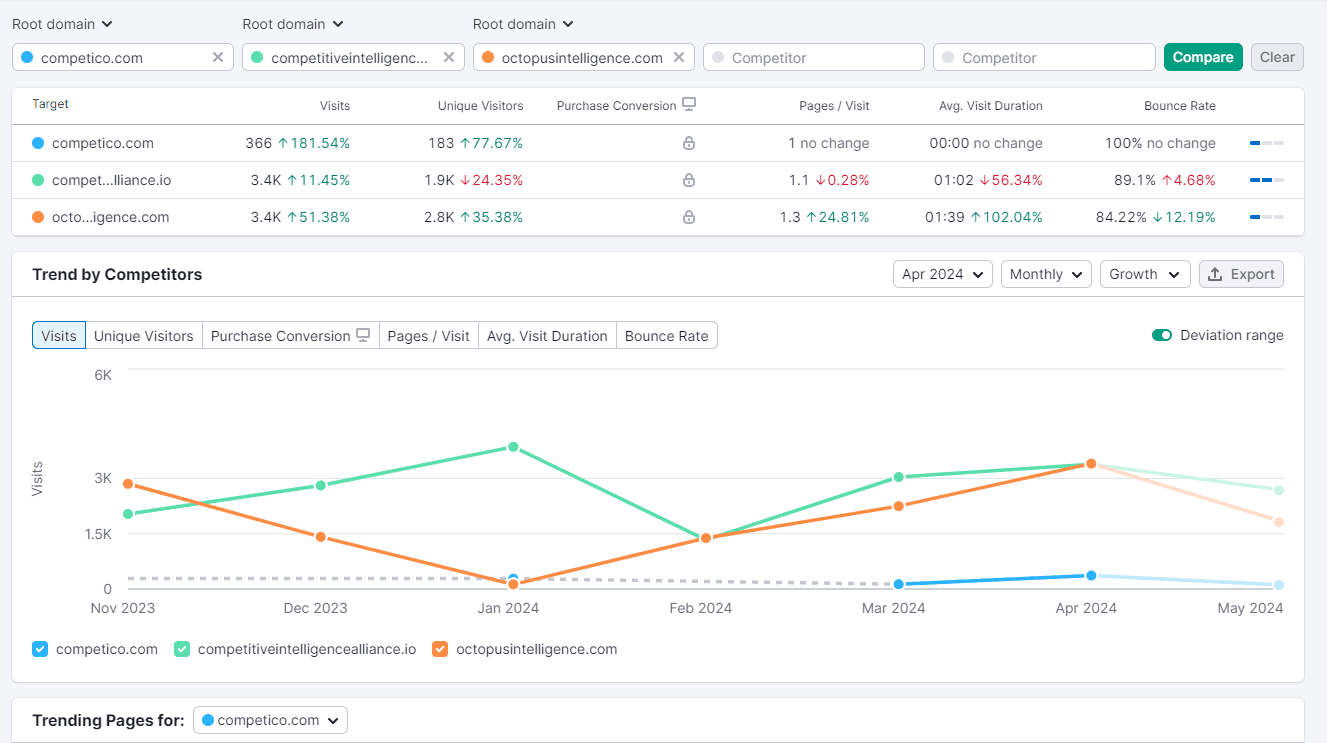
I’ll be upfront: Semrush is the tool I use most in my day-to-day work at Competico. Not because it’s the most powerful on every individual dimension, because it isn’t, but because it’s offering most of the digital intelligence I need, and it also has a good price-to-benefit ratio.
The integrated workflow from keyword research to content audit, organic and total traffic estimation, and paid ads is unmatched in depth.
When I onboard a new client, it’s set up within the first 48 hours. I’ve previously written an in-depth guide to competitive analysis using Semrush. I suggest checking if you are not familiar with it.
The feature I rely on most is the Keyword Gap tool. I run it at the start of every SEO engagement: enter the client domain and three to five competitors, and within minutes, I have a prioritized list of keywords they rank for that my client does not. In one recent engagement, this surfaced 47 high-intent, low-difficulty keywords that a competitor had cornered. We systematically targeted them over the following quarter.
Semrush now includes AI Toolkit features for tracking AI Overview appearances. It’s not a replacement for dedicated AI visibility tools, but it’s the most practical entry point for teams already in the Semrush ecosystem.
- Data Accuracy: 9/10
- Feature Depth: 9.5/10
- UX & Speed: 8.5/10
- AI Visibility Readiness: 8.5/10
- Value for Money: 8/10
Competitors App — My Daily Driver for Real-Time CI
My Score: 8.7 / 10
Best For: Teams that need a single pane of glass across social, SEO, email, ads, and website changes without enterprise pricing.
CompetitorsApp monitors website changes, social posts, email campaigns, ad creatives, SEO shifts, and review scores in a single dashboard, with email digests I send directly to stakeholders.
The automated reporting alone has saved me an estimated 3–4 hours per client per week that I used to spend collating updates manually. Alert volume can overwhelm you if you don’t tune the filters in the first week. The integrations with HubSpot or Slack are limited compared to Crayon or Klue.
What Surprised Me After 30 Days
The LinkedIn tracking was sharper than I expected at this price point. It caught a competitor’s organic pivot from thought leadership to product-led content two weeks before that shift showed up in their traffic data — giving my client early warning to prepare a counter-narrative.
- Data Accuracy: 8/10
- Feature Depth: 8.5/10
- UX & Speed: 9/10
- AI Visibility Readiness: 7/10
- Value for Money: 9.5/10
Crayon — The Gold Standard for Sales-Oriented CI
My Score: 8.2 / 10
Best For: B2B companies with active sales teams fighting competitive deals daily.
Crayon is what happens when a CI platform is designed by people who’ve sat in on losing sales calls. The battlecard system is the best I’ve used: well-structured, easy to update, and actually used by sales reps rather than collecting dust in Notion. The real-time intelligence feed pulls from pricing pages, job postings, G2 reviews, and press releases, and its curation layer keeps signal-to-noise manageable.
The honest downside: pricing is opaque and starts at a level that prices out smaller teams. If you’re closing six-figure deals and losing 20% to three known competitors, the ROI math works quickly. If you’re a 5-person startup, this isn’t your tool.
Klue — Best for Cross-Functional CI Sharing
My Score: 8.0 / 10
Best For: Organizations where CI needs to flow from marketing to sales to product simultaneously.
Klue’s differentiator is its organizational architecture. Where most CI tools are built for a single team, Klue is designed to be the system of record for the entire company. Sales gets battlecards. Product gets feature gap reports. Marketing gets messaging alerts. I implemented it for a 400-person SaaS company, and within 90 days, it had replaced four Confluence wikis, two Google Sheets trackers, and a Slack channel that had devolved into noise.
Best CI Tools for SEO
Semrush — The Most Complete SEO Competitive Suite
My Score: 9.1 / 10
Best For: Keyword gap analysis, on-page SEO audits, and tracking competitor content strategies at scale.
⚠ Ownership Update (May 2026): Adobe announced the acquisition of Semrush for approximately $1.9 billion in November 2025. The deal is expected to close in the first half of 2026. Semrush continues to operate independently, and there is no change to current plans or pricing — but anyone making a long-term platform decision should factor in potential integration into Adobe’s ecosystem.
Ahrefs — The Definitive Backlink Intelligence Platform
My Score: 9.0 / 10
Best For: Backlink research, link gap analysis, and reverse-engineering competitor content authority.
There are things Ahrefs does that no other tool matches. The backlink database is the most accurate I’ve worked with, and the lost/gained links feed has caught competitor link-building campaigns before they registered anywhere else. The Content Gap, combined with the “Best by Links” report, is a systematic process for building authority in competitive niches starting from zero.
One underrated feature for CI: the Traffic Value metric. It estimates what a competitor would pay in Google Ads to replicate their current organic traffic. That single number is a more honest measure of SEO investment than raw traffic, and I include it in nearly every competitive audit I produce.
Ahrefs also launched Brand Radar (March 2025) — a dedicated AI visibility layer processing 370 million prompts monthly across all major LLMs. Covered in the AI Visibility section below.
- Data Accuracy: 9.5/10
- Feature Depth: 9/10
- UX & Speed: 8.5/10
- AI Visibility Readiness: 8.5/10
- Value for Money: 8.5/10
Moz & Ubersuggest — When Budget Is the Constraint
Moz — 7.4 / 10: Still the best option for teams just building their SEO muscle. The Domain Authority metric remains a widely understood proxy for site authority that clients grasp immediately — which matters when you’re presenting competitive reports to non-technical stakeholders. For pure depth, Moz trails Semrush and Ahrefs significantly, and its feature velocity has slowed in recent years. At $99/month with a genuinely beginner-friendly interface, it punches above its weight for lean teams.
Ubersuggest — 6.8 / 10: At $12/month, Ubersuggest offers surprisingly functional competitive keyword and traffic overviews. For early-stage competitive research where the ROI of Semrush doesn’t justify the spend, it’s a credible starting point. Historical depth and backlink accuracy fall well short of premium tools.
CI Tools for PPC
SpyFu — The Best Tool for Reverse-Engineering Competitor Google Ads
My Score: 8.5 / 10
Best For: PPC teams who want to see exactly which keywords competitors have tested, kept, and abandoned.
SpyFu’s historical ad data is its superpower. I’ve used it to reconstruct a competitor’s entire Google Ads testing history — which keywords they started bidding on, which they dropped after 60 days, which ad copies they’ve been running unchanged for 18 months (usually a signal something is working).
The most actionable use case I’ve found: identifying keywords that multiple competitors tried and abandoned. That’s often a signal of poor commercial intent despite high volume — a pattern that saves significant budget when you catch it before launching a campaign. At $39/month, SpyFu is one of the highest-value tools in this entire list relative to cost.
CI Tools for Social Media
Sprout Social — The Most Actionable Social Competitive Data
My Score: 8.1 / 10
Best For: Social media managers who need competitor benchmarking integrated into their publishing workflow.
Sprout’s competitive reports go beyond vanity metrics. Where most tools show follower counts and engagement rates, Sprout breaks down which content formats, posting times, and topic clusters are driving competitor performance. I used it during a client’s brand refresh to identify exactly which emotional themes a key competitor was leaning into — and found a gap in “customer success stories” format they had completely ignored. The $249/month is a real barrier for small teams, but for brands where social is a primary acquisition channel, the depth of insight justifies it.
Buffer — 6.5 / 10: Covers the basics cleanly. If you primarily need social scheduling with basic competitive context — not the other way around — it delivers honest value at $6/month. For serious competitive social analysis, step up to Sprout.
CI Tools for Social Listening
Mention & BrandMentions — Mid-Market Monitoring
Mention — 7.5 / 10: The best real-time brand monitoring for mid-market teams. Sentiment classification is solid, alert speed is genuinely fast — notifications within minutes of a significant mention going live. One of the cleaner UIs in the social listening category.
BrandMentions — 7.4 / 10: Adds an influencer dimension to standard brand monitoring. When a competitor starts being mentioned by specific voices in your industry, it’s often an early signal of a coordinated PR or co-marketing push. BrandMentions catches that pattern earlier than simpler tools.
CI for Website Traffic
SimilarWeb — The Most Comprehensive Traffic Intelligence Platform
My Score: 8.6 / 10
Best For: Understanding where a competitor’s traffic actually comes from, and how their audience distribution compares to yours.
SimilarWeb is the tool I open first when onboarding a new client and need a rapid strategic context brief. Within 15 minutes, I can map a competitor’s entire traffic mix: direct vs. organic vs. paid vs. referral vs. social, with geographic and device breakdowns. That overview shapes everything else in a CI engagement.
The audience overlap analysis is particularly powerful. Seeing that a competitor gets 40% of its traffic from a single referral partner, my client has never pursued is the kind of structural insight that directly informs partnership strategy. The data is modeled, not precise — treat it as a directional strategy, not media planning.
CI Tools for Website Change Detection
VisualPing — 7.3 / 10: Does one thing well — alerts you when a monitored page changes. I use it on competitor pricing pages, product feature pages, and job postings as a low-cost early warning system. At $10/month for 25 pages, it’s nearly impossible to argue against including it in any CI stack.
Distill.io — 7.1 / 10: Handles JavaScript-rendered content that VisualPing often misses. For SaaS competitors whose pricing or feature pages update dynamically, this capability is essential. Requires slightly more technical fluency but is manageable for most marketing operators.
CI Tools for Financial & Technology Intelligence
Crunchbase — 7.8 / 10: Essential for tracking competitor funding rounds, acquisitions, and executive hires as signals of strategic direction. A competitor closing a Series B means they’re about to hire aggressively, expand into new segments, and potentially reprice. Crunchbase closes the 90-day gap between a round closing and it appearing in news coverage.
Owler — 7.0 / 10: Revenue estimates are modeled approximations, not audited figures — I always caveat that in client reports. As a directional signal of relative competitor scale, it’s a useful input that arrives faster than file-based sources.
BuiltWith — 7.9 / 10: Expensive at $295/month and highly specialized, but irreplaceable in the right context. I used it on an engagement where a competitor’s growth trajectory didn’t match its apparent team size. BuiltWith revealed a sophisticated marketing automation stack that fully explained the discrepancy and reshaped my client’s technology investment priorities.
CI Tools for Content Strategy
BuzzSumo — Content Performance Competitive Analysis
My Score: 8.0 / 10
Best For: Identifying which competitor content pieces are generating the most shares, backlinks, and engagement — and why.
⚠ Ownership & Pricing Update: BuzzSumo is now part of Cision (via Brandwatch). Entry pricing has increased significantly — currently $199/month for the Content Creation plan, up from $99/month in earlier versions of this guide. Factor Cision’s enterprise-focused roadmap into any long-term decision.
BuzzSumo’s core value: show me what’s working, not just what was published. For content-driven businesses, seeing a competitor’s top-performing articles by share count, filtered by format and date, is genuinely strategic intelligence. On two occasions, acting on a BuzzSumo trend alert within a week produced content that ranked higher than a more authoritative competitor’s version before it was even published.
Frase — 7.6 / 10: Where BuzzSumo tells you what performed, Frase tells you how the top-ranking content is structured. Its automated SERP analysis — headers, word counts, question coverage, topic clusters from the top 10 results for any keyword — makes it an indispensable pre-writing tool. At $45/month, it’s a no-brainer for content-heavy teams.
CI Tools for AI Visibility Intelligence
This is where most competitive analysis articles written before 2025 fall completely flat. Search is no longer just Google. In 2026, a meaningful and growing share of discovery happens through AI-generated answers in Google AI Overviews, Perplexity citations, ChatGPT Search, and Microsoft Copilot responses.
If your competitor is being cited in AI answers for your target queries and you aren’t — that gap is compounding every day. Traditional rank tracking doesn’t catch it. You need a separate monitoring layer.
What AI Visibility CI Actually Monitors
- Brand & competitor citation frequency — How often are you (and your competitors) named in AI-generated answers for your target queries?
- Share of AI Voice — Among the brands cited for a keyword cluster, what percentage of responses name you vs. them?
- Source and citation patterns — Which specific pages and domains are being pulled into AI answers? Which competitor content is being cited and from where?
- Sentiment in AI responses — When you are cited, is the context positive, neutral, or negative?
- Schema and structured data signals — FAQPage, HowTo, Product schema implementation that feeds AI citation eligibility.
- E-E-A-T signal density — AI engines favor content with demonstrated first-hand experience and expertise. The CI question shifts from “how long is their article” to “how credible is their author signal.”
Otterly.ai — Best Entry Point for AI Visibility Monitoring
My Score: 8.2 / 10
Best For: SMBs and solo operators who need automated AI citation monitoring without enterprise pricing.
Otterly.ai is where I recommend most teams start when it comes to AI visibility tracking. It monitors brand mentions and citations across ChatGPT, Google AI Overviews, Google AI Mode, Perplexity, Gemini, and Microsoft Copilot in a single dashboard. The GEO audit feature surfaces crawlability gaps and content optimization recommendations — not just data, but actionable next steps.
What I particularly value: competitive benchmarking at the prompt level. You can see which brands appear alongside (or instead of) yours for specific query clusters. That’s the AI-search equivalent of a keyword gap report — and it’s equally actionable.
Otterly was recognized as a Gartner Cool Vendor in 2025. At $29/month entry, it’s the most accessible dedicated AI visibility tool available. The Lite plan is capped at 15 prompts, which limits depth — the Standard plan at $189/month is what I’d recommend for any serious monitoring setup.
- Data Accuracy: 8/10
- Feature Depth: 8/10
- UX & Speed: 8.5/10
- AI Visibility Readiness: 9.5/10
- Value for Money: 8.5/10
Profound — Enterprise-Grade LLM Citation Intelligence
My Score: 8.6 / 10
Best For: Larger organizations that need deep, compliant AI visibility analytics with competitive benchmarking at scale.
Profound is the most analytically deep AI visibility platform I’ve evaluated. Its Answer Engine Insights tracks exactly how and where your brand appears across ChatGPT, Perplexity, Google AI Overviews, and Copilot — including the context of citations, the sources being used, and where competitor mentions dominate. The Conversation Explorer maps the questions consumers are actually asking AI platforms, surfacing intent patterns that don’t show up in traditional keyword research.
The honest limitation: it starts at ~$399/month and is built for enterprise budgets. For a 5-person marketing team, Otterly.ai covers 80% of what Profound offers at 7% of the price. For a 200-person brand where AI citation strategy is a boardroom-level discussion, Profound’s depth and SOC 2 compliance justify the investment.
- Data Accuracy: 9/10
- Feature Depth: 9/10
- UX & Speed: 8/10
- AI Visibility Readiness: 9.5/10
- Value for Money: 7/10
Ahrefs Brand Radar — Best If You’re Already in the Ahrefs Ecosystem
My Score: 8.4 / 10
Best For: SEO-first teams who want AI visibility intelligence without adding another standalone tool.
Ahrefs launched Brand Radar in March 2025, processing over 370 million prompts across all major LLMs every month. The AI Share of Voice reporting is particularly strong — it shows not just whether you’re cited, but how your citation rate compares against direct competitors across keyword clusters. This makes it the most natural upgrade for teams already using Ahrefs daily.
The $699/month add-on pricing on top of an existing Ahrefs subscription is steep, and it only makes sense if you’re already committed to the Ahrefs ecosystem. If you’re starting fresh with AI visibility as your primary goal, Otterly.ai or Profound is a better place to start.
My Current GEO Competitive Monitoring Process
Every two weeks, I run a structured query test across 20 high-priority keywords in ChatGPT, Perplexity, and Google AI Overviews, logging which competitors are cited and in what context. Otterly.ai handles the automated baseline. This 2-hour audit has flagged two competitor content plays early enough for clients to respond — once by accelerating FAQ schema implementation, and once by commissioning an authoritative guide that displaced a competitor within 60 days.
How to Build a CI Stack: My Matrix
After nine years of building CI programs, here’s the framework I use with every client. The question is never “do we have enough tools” — it’s “are the tools we have producing decisions we wouldn’t make otherwise?”
Stage 1: The $100/Month Minimum Viable Stack
- Ahrefs or Semrush ($29–$140): Non-negotiable for any content or SEO strategy.
- Competitors App ($20): Multi-channel monitoring — social, website, email, ads in one place.
- SpyFu ($39): If PPC is in your channel mix, this pays for itself within weeks.
- Otterly.ai ($29): Start your AI visibility baseline now — the gap compounds daily.
Stage 2: The $500/Month Growth Stack
- Semrush + Ahrefs (both as the data cross-reference is worth it)
- SimilarWeb ($125): Traffic source intelligence becomes essential at this stage.
- Sprout Social ($249): If social is a meaningful acquisition channel.
- VisualPing ($10): Always.
- Crunchbase ($29): Financial signals for strategic planning.
- Otterly.ai Standard ($189): Upgrade to serious AI visibility monitoring.
Stage 3: The Enterprise CI Stack ($2,000+/Month)
- Crayon or Klue: Your CI system of record.
- Semrush + Ahrefs: Full SEO coverage.
- SimilarWeb: Traffic modeling.
- BuiltWith: Tech stack intelligence.
- Mailcharts: Email strategy benchmarking.
- Crunchbase + Owler: Financial monitoring.
- Profound: Enterprise AI citation and visibility intelligence.
Common CI Mistakes I See Constantly
- Monitoring too many competitors. Pick three to five. Shallow coverage of ten is worse than deep coverage of three.
- Treating CI as a quarterly exercise. Competitive intelligence has value decay. A battlecard built six months ago may be actively misleading today.
- Mistaking outputs for insights. A dashboard full of data is not intelligence. Every CI review should end with a decision or recommended action.
- Ignoring the why behind competitor moves. If a competitor doubles their content output, the interesting question isn’t “how much are they publishing” — it’s “what do they know about the market that we don’t?”
- Skipping AI visibility entirely. If you’re not tracking where your competitors appear in AI-generated answers, you’re monitoring the 2022 version of search. This gap is growing every quarter.
- Over-investing in tools before building the process. A $100/month stack with a clear workflow beats a $3,000 stack with none.
Frequently Asked Questions
What is the best competitive analysis tool overall in 2026?
For most teams, Semrush (or Ahrefs) plus Competitors App covers the majority of CI needs at a reasonable budget. If the budget allows only one, choose based on your primary channel: SEO-driven businesses should prioritize Semrush or Ahrefs; multi-channel businesses should start with Competitors App.
What is the best free competitive analysis tool?
Google Alerts provides basic brand and competitor mention monitoring at no cost. For SEO, the free tiers of Ubersuggest and Moz’s browser extension offer limited but functional data. For AI visibility, HubSpot offers a free AEO Grader that gives a quick snapshot. Most paid tools offer 7–14-day free trials. I recommend Semrush’s trial period to run a full competitive audit before committing.
How many competitors should I track?
Three to five direct competitors with depth, plus five to ten indirect competitors with automated alerts only. Tracking fewer competitors consistently and well outperforms tracking many competitors superficially.
How often should I run competitive analysis?
Automated monitoring should run continuously. Structured competitive reviews — where you synthesize data to inform strategic decisions — should occur monthly in fast-moving markets and quarterly in stable ones. AI visibility audits should run at a minimum bi-weekly, given how rapidly citation patterns shift.
How do competitive analysis tools help with AI visibility?
Dedicated AI visibility tools like Otterly.ai, Profound, and Ahrefs Brand Radar track which brands are being cited in AI-generated answers, at what frequency, and in what context. For broader CI, monitoring competitor structured data implementation, E-E-A-T signals, and topical authority clusters gives a forward-looking view of where competitors are likely to gain AI citation advantage before it registers in traditional rank tracking.
How does the Adobe acquisition affect Semrush?
Adobe announced the acquisition of Semrush for approximately $1.9 billion in November 2025. As of publication, Semrush continues to operate independently with no changes to plans, pricing, or features. The long-term roadmap implications — particularly around integration with Adobe Experience Cloud — are not yet public. Teams making multi-year platform commitments should monitor this closely.
The Bottom Line
The right CI stack is a force multiplier, but it amplifies the process rather than replacing it. After nine years at Competico, the single factor most predictive of whether a CI program delivers ROI is not which tools are in the stack — it’s whether someone owns the practice and converts data into decisions consistently.
If you’re just starting, use Semrush or Ahrefs, Competitors App, and Otterly.ai. Learn them deeply before adding complexity. Build the habit before building the stack.
In 2026, the competitive landscape is moving faster than any previous era I’ve operated in. AI is reshaping how buyers discover, evaluate, and choose. The companies that win are those who institutionalize the discipline of knowing what their competitors know — including where they show up in AI answers — and knowing it sooner.
Ready to Build Your CI Stack?
Competico helps growth-stage companies build and run competitive intelligence programs that drive decisions, not just dashboards. If you’d like a personalized tool recommendation or a CI program audit, reach out at competico.com.