

At WordCamp Europe in Kraków, I wanted to know whether AI Visibility had gone mainstream among WordPress businesses. At Affiliate World in Budapest, I tested whether performance marketers had accepted that rank-and-monetize is over.
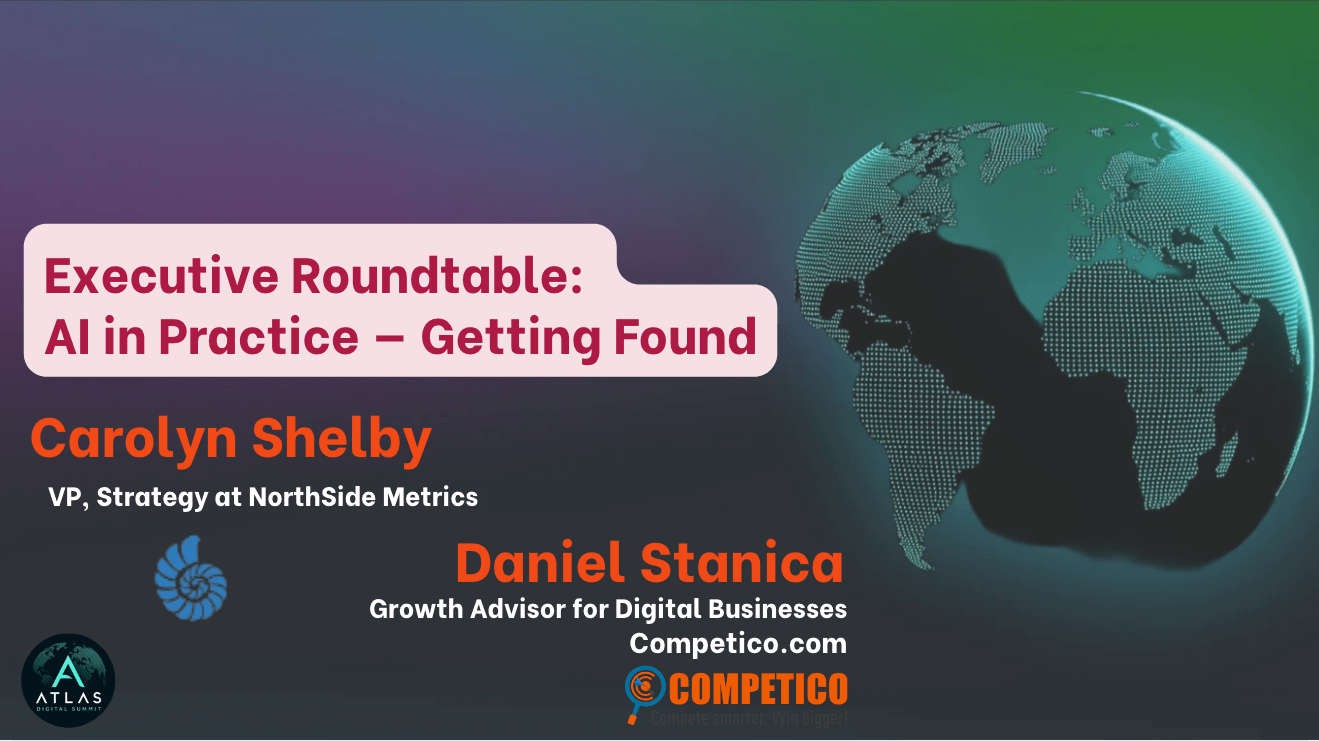
For me, Atlas Digital Summit 2026 was the third test, and the toughest audience yet. Together with Carolyn Shelby, I co-hosted a roundtable for C-level executives from hosting, infrastructure, and cybersecurity companies. The question this time: have senior decision-makers moved from awareness to execution? The answer is mostly yes. Nobody asked whether search had changed. Every question was about operations: what to fix, whom to trust, what to measure, and where to put the budget.
This is the executive-level takeaway. If you prefer the session as it unfolded, I wrote a separate first-person recap on my personal website at DanielStanica.com. You may check it here: AI Visibility Tips I shared at Atlas Digital Summit’s Roundtable.
TLDR
Senior leaders in hosting, infrastructure, and security already know that AI Overviews and LLM-driven search are shortening the customer journey and shrinking organic traffic. What they lacked was an operating model. The roundtable pointed to four moves: publish accessible, clear facts on your own site; build a consistent identity supported by independent evidence; compete through honest comparison content instead of self-ranking lists; and measure with a repeated prompt panel and revenue, not traffic. AI is more likely to recommend entities that are clear, consistent, and independently supported, so that is the goal.
Why the Old Playbook Stopped Paying
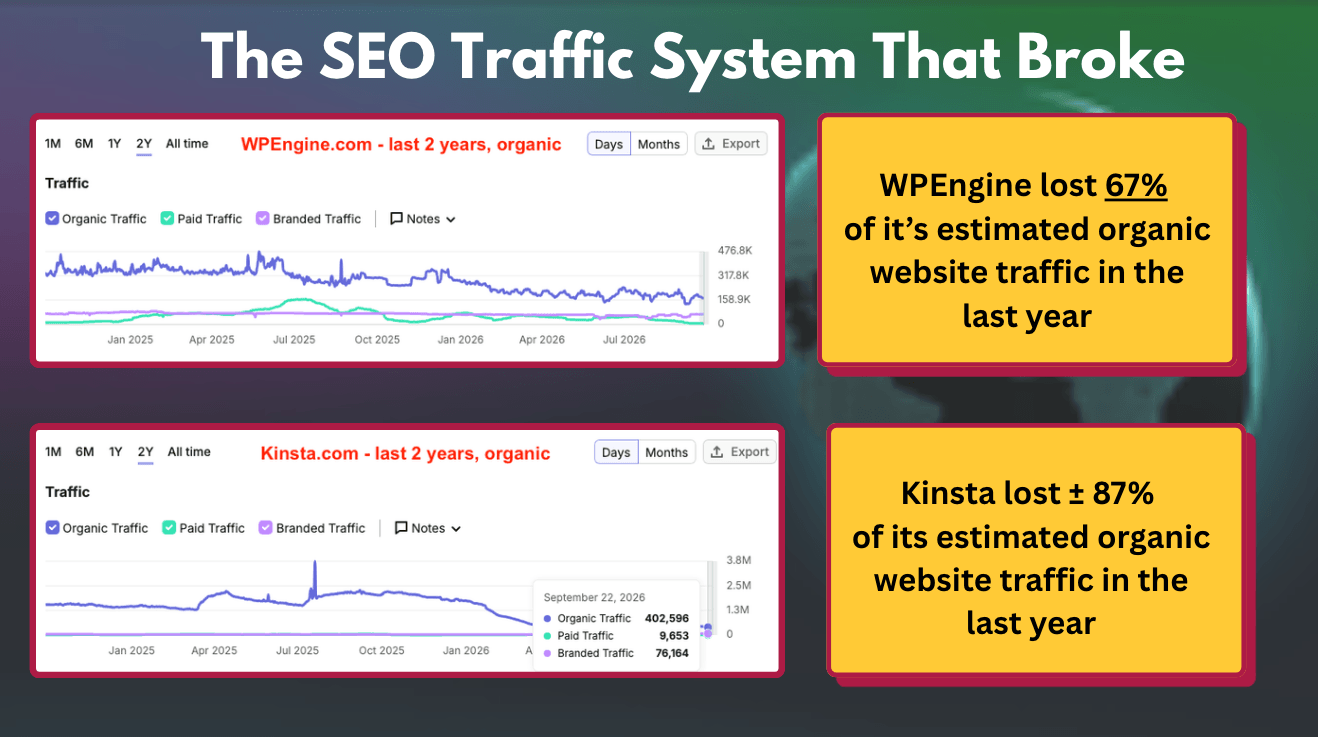
My opening argument rested on the data from the AI Visibility audits I run for clients. In the Great Blogging Collapse study, which follows 100 business blogs, organic search traffic has fallen 60-75% since 2022. Hosting shows the same pattern at the brand level: Semrush estimates that WP Engine and Kinsta lost 77-85% of their organic traffic in the last year alone.
You can see the cause on the results page itself. AI Overviews sit above the classic blue links and push them below the fold, while YouTube, Reddit, and forum threads take up much of the remaining space.
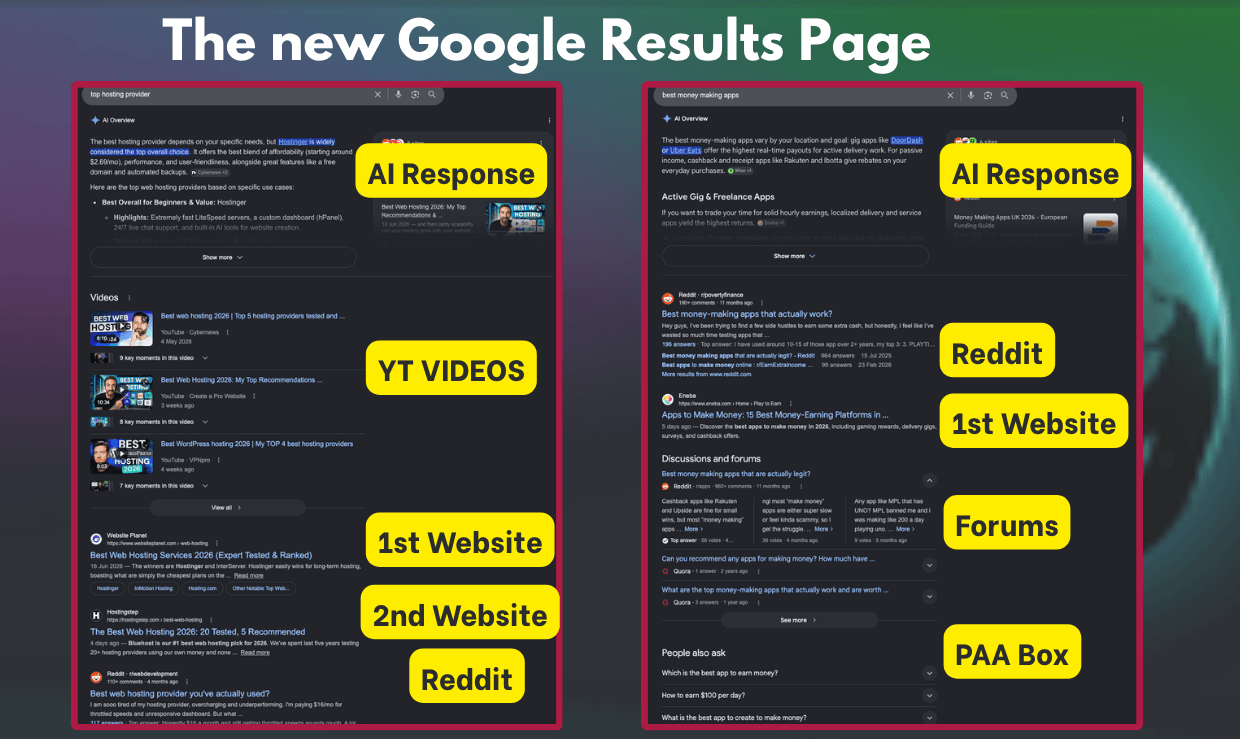
Carolyn pointed out that the slide began before AI Overviews. She dates it to Google’s Helpful Content Update, with AI Overviews accelerating it by folding the whole journey into a zero-click answer.
Exposure differs by model. Businesses living on ad-supported informational content take the hardest hit, while e-commerce and service businesses fare better because transactional queries still produce visits.
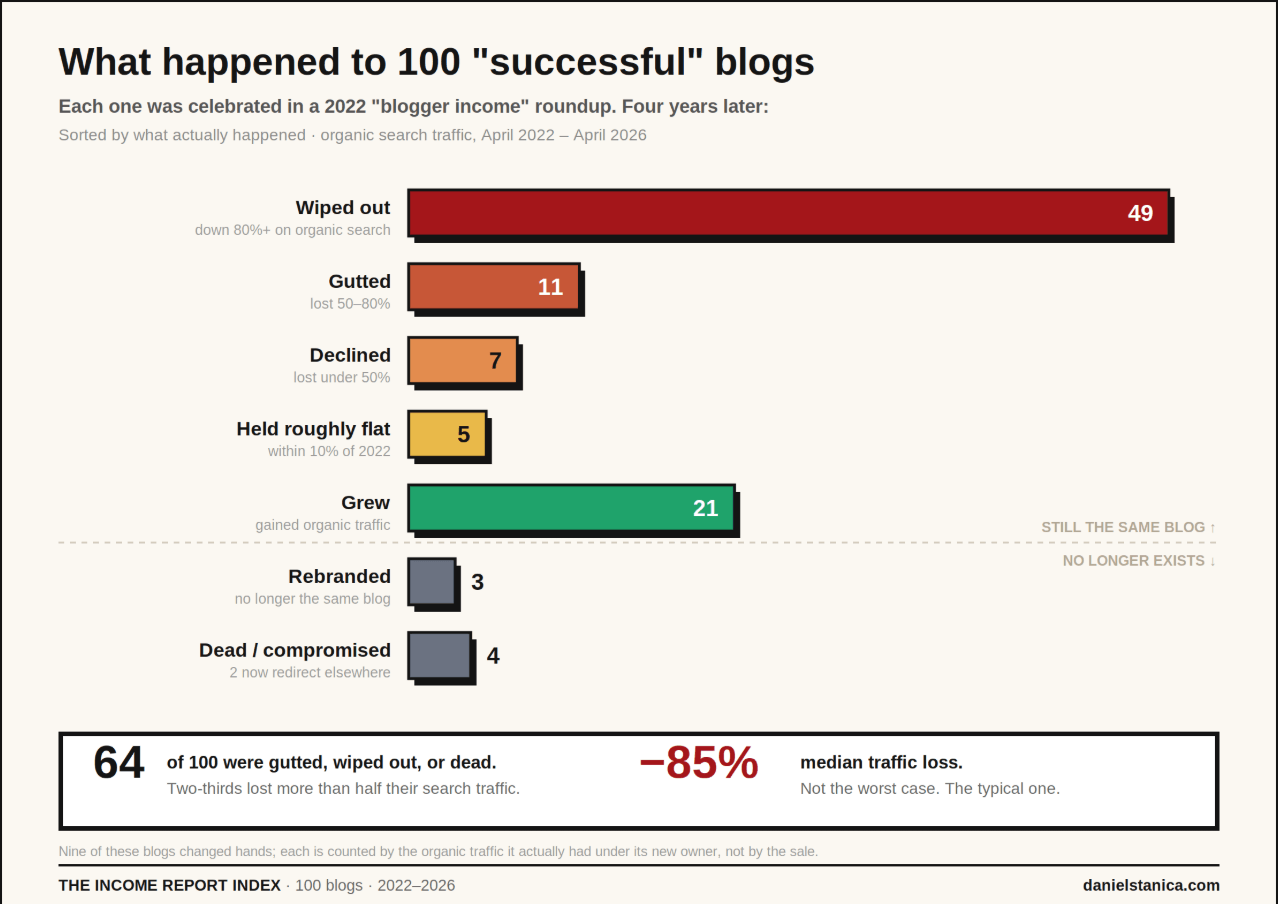
For hosting providers, the knock-on effect is customer churn. Ad-funded sites are likely to be abandoned, which hits the low-price tiers built around them. Small businesses still need a site of their own, so SMB-focused hosts keep a durable market.
Three Statistics Worth Knowing
One slide in the session gathered recent figures that explain why the old metrics mislead.
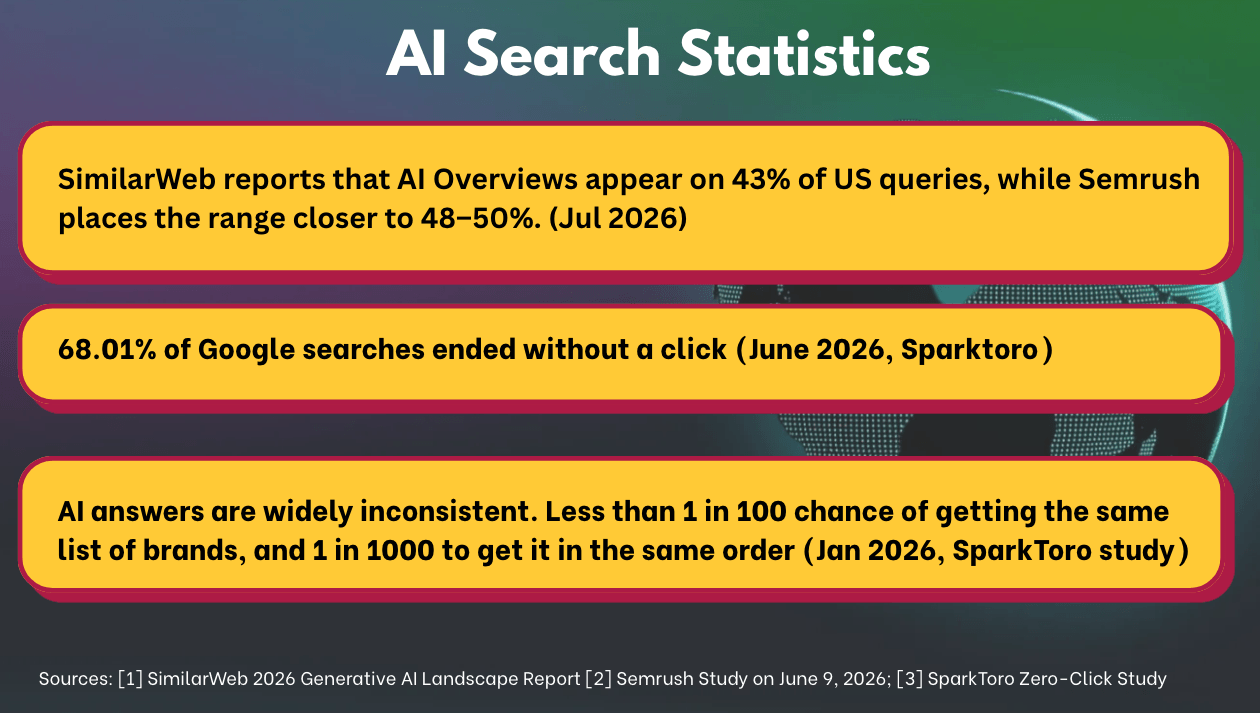
- AI Overviews reach about half of US queries. SimilarWeb measures 43%, and Semrush puts it closer to 48-50% (July 2026). The sources differ on the exact share, but neither suggests a niche feature.
- 68.01% of Google searches end without a click (SparkToro, June 2026). Ranking well no longer guarantees a visit, so traffic understates how much demand you actually influence.
- AI answers rarely repeat themselves. A January 2026 SparkToro study found a chance of less than 1 in 100 of seeing the same brand list twice, and around 1 in 1,000 of seeing it in the same order.
The third figure matters most for budgeting. A single prompt check proves almost nothing, because a brand missing once may have been unlucky. You need a repeated prompt panel, sampled many times and read as directional visibility rather than market share.
Move 1: Make Your Website the Clear, Accessible Source
Carolyn’s most actionable advice concerned the website. Her instruction, in her words:
Make essential facts accessible as text, with enough context to remain clear without styling, JavaScript, or clicks. Retrieval capabilities vary by platform; schema is not a substitute for accessible content.
Three supporting habits came with it:
- Be specific and back claims with evidence. Vague claims tend not to get cited.
- Identify yourself plainly. Use the brand name in the headings, the title, and the body copy.
- Cover the topic, not just the keyword. Models work with meaning. Add bridge content that matches how people phrase conversational questions.
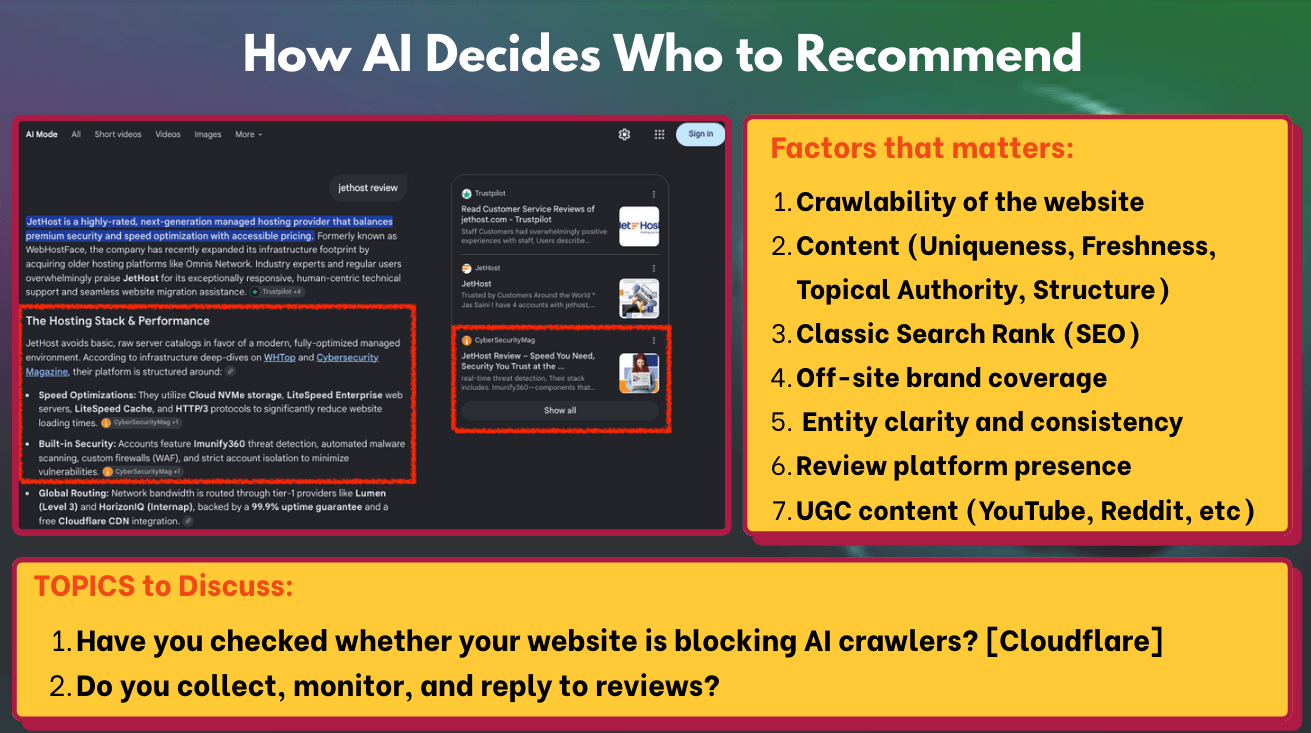
Her principles overlap with several factors in the seven-factor framework I use in client audits: crawlability, fresh and unique content, topical authority, structured answers, brand and entity coverage, web consensus, and platform strategy. It was reassuring to see an independent practitioner reach similar conclusions. It is also why I finally built a personal website after twenty years of not needing one: an authoritative page about yourself is now a business asset.
Move 2: Earn Independent Evidence, Not Just Repetition
Consensus came up repeatedly, and Carolyn was careful about how to frame it:
Consistent identity and independent supporting evidence are useful areas to audit, but agreement across sources does not establish truth or guarantee an AI recommendation.
Her slide drew a line between independent proof and mere repetition, for a company, that translates into two jobs. First, keep your entity data consistent across your site, Wikidata, Wikipedia, LinkedIn, and third-party listings. Second, earn mentions from sources that have no stake in promoting you.
Her first practical step is an audit. Ask AI systems what they say about your brand, trace any errors to their source page, and correct them there. Speed matters, since conflicting information piles up.
One caution from my own testing: quick positioning can sway an AI’s description of a brand for a short time, but it tends to drift back as more data accumulates. Durable shortcuts don’t exist.
Move 3: Compare Honestly Instead of Ranking Yourself First
Self-crowning “best of” pages damage credibility, and in the cases I’ve reviewed, they often work for the competition. AI may favor bigger, well-corroborated entities that appear across many comparison pages.
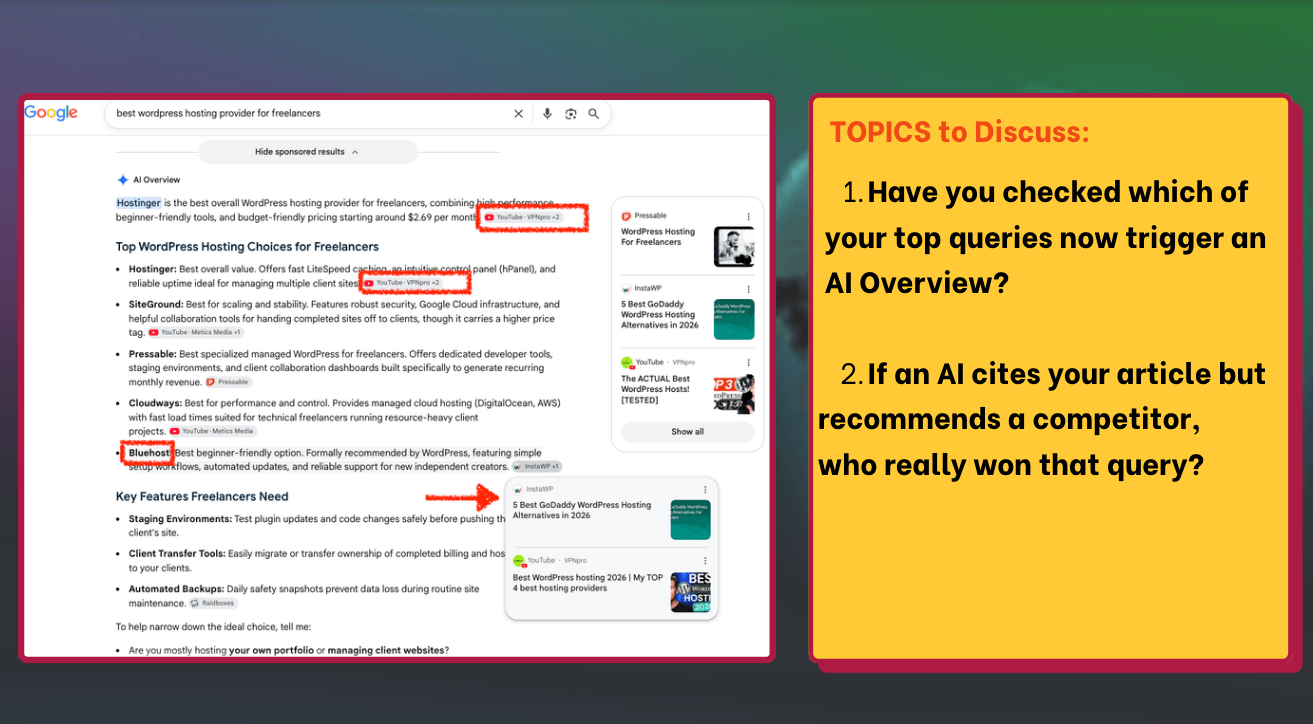
The example I showed: Google recommended Bluehost, yet the page it cited as the source belonged to a competitor, InstaWP. That does not prove causation, but a couple of studies (one and two) also report a decline in self-promoting listicles.
Carolyn’s recommended alternative is explicit comparison content that names competitors. For brand-inclusive questions, hinting won’t do. State the alternatives, explain where you fit, and let the evidence carry the argument.
Move 4: Treat YouTube and Reddit as Earned Channels
AI products often surface video, and authentic transcripts make it easier to extract. Reddit is influential but unstable: one participant cited an 86% drop in Reddit citations, so it should not be your only bet.
The room agreed on the line between acceptable and unacceptable. Covert seeding is out. Genuine contributions from real users, affiliates, and clients are in. Carolyn suggested using agents to find relevant threads and draft sincere replies, reporting abuse, and accepting that moderation is outside your control.
Move 5: Measure Direction, Not Traffic
When traffic stops tracking demand, the scorecard has to change. Three components came out of the discussion:
- A repeated prompt panel in AI answers, sampled many times because outputs are probabilistic. It gives directional visibility within the sampled questions and platforms, not a measure of overall market share. Count mentions, citations, and recommendations separately.
- Correlation of direct and referral spikes with your content efforts
- Revenue, which matters more than traffic counts
A slide from the session explains why analytics alone mislead. An AI tool often recommends a brand without a clickable link, or links somewhere other than the brand’s own site. A user who then types the brand name into the browser is logged as direct. A user who clicks through from a third-party page that cites the brand is logged as referral. Either way, discovery began in an AI tool, and your reports credit it to the wrong channel.
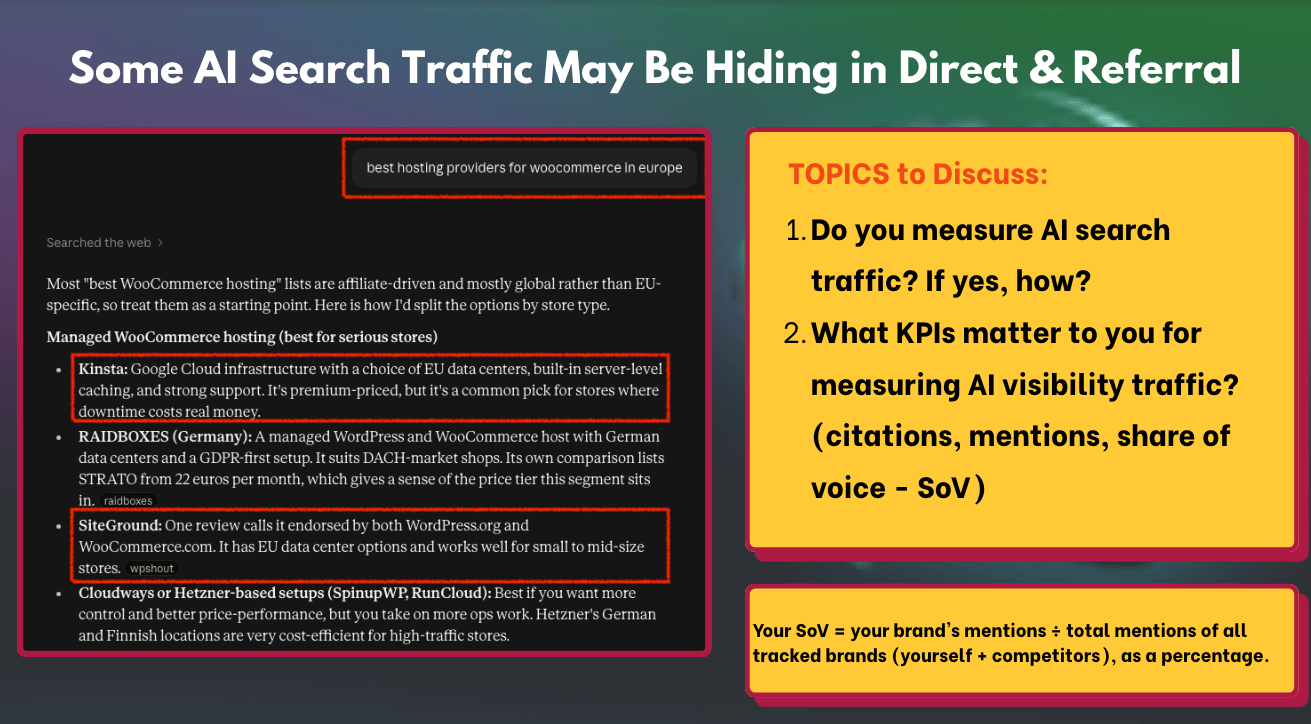
Carolyn likened this to advertising before digital tracking, when decisions rested on imperfect signals. Because citations can be missing or misattributed, no single reading deserves much trust. For non-branded prompts and citation sources, she suggested prompt-tracking tools such as Serp Recon.
A participant also shared a useful routine: define buyer personas (photographers, publishers, and so on), prompt AI as each one, and use “explore” prompts to uncover questions you wouldn’t think to ask. Personas help you reproduce how real prospects search, with prompts like “best WordPress hosting in Europe for photographers.”
Move 6: Buy Placements Deliberately
Marius Lazarescu raised the budget question: if AI is the audience, how should a team pick publishers for sponsored content? He questioned the habit of sticking to niche sites and wanted a way to weigh price against quality across a long list.
Carolyn’s approach starts with publishers AI results already cite, then checks that their pages are accessible to bots. After that, widen the net to top-cited general sites so you don’t saturate one niche. She added a two-part rule:
- New entities should prioritize quantity to build presence.
- Established entities should prioritize quality.
My addition was to scale in stages: place a batch, measure citation changes, and only then expand.
Where to Start: Audit, Fix, Measure, Scale
The six actions from the session fall into four phases:
- Audit. Check what AI says about your brand and trace errors to their source.
- Fix. Make essential facts accessible as text, clear without styling, JavaScript, or clicks (I use Screaming Frog for this check). Replace self-serving listicles with honest comparisons. Align your entity data across Wikidata, LinkedIn, and major listings.
- Measure. Set up a repeated prompt panel and count mentions, citations, and recommendations separately.
- Scale. Expand third-party placements in measured steps.
What Atlas Digital Summit 2026 Confirmed
Kraków, Budapest, and Atlas are different rooms with a shared direction. Atlas added three points:
- Execution is the bottleneck, not awareness. These executives understand the shift. They want a sequence: what to audit, what to fix first, and how to show it worked.
- Your site is the source, but trust comes from independent evidence. Repetition doesn’t count as proof, so brands that rely on self-promotion tend to lose citations to sources others support.
- Measurement has to change before budgets do. Traffic lags and increasingly misleads. A repeated prompt panel and revenue correlation give a more honest picture, as long as you read them directionally.
Organic search isn’t dead, but the job has changed from ranking pages to becoming an entity that is clear, consistent, and independently supported.
On Tuesday, October 6, 2026, Carolyn Shelby presents the online SMX session “Optimizing content for AI search and agents,” with the agenda starting at 11:00 a.m. ET. Details here.
If you run a hosting, infrastructure, or technology business and see organic traffic decline while AI tools recommend your competitors, that is the exact problem we solve at Competico. Let’s talk for a non-binding 20-minute consultation.
Thanks to Carolyn, Marius, and everyone who joined the table.