
This is the Competico takeaway. If you prefer the talk section by section, with the full WordPress checklist and AI Visibility self-audit, I wrote a first-person recap on my personal website: AI Visibility at Bucharest WordPress Meetup: Recap.
TL;DR
At the Bucharest WordPress Meetup, about 50 site owners, freelancers, and agency people showed that AI Visibility is no longer a conversation reserved for enterprise and conference stages. Local data backs this up: 70% of Romanians aged 18–55 use AI, and 91% of them use it to look up brands or products. The room did not need the “why.” They needed a sequence: what to check, what to fix on WordPress first, and how to tell whether it works. Most of the highest-impact fixes are settings in plugins they already run.
The AI Visibility Shift Has Reached the Devs
At WordCamp Europe in Kraków, I asked whether AI Visibility had become a mainstream concern for WordPress businesses. At Affiliate World in Budapest, I tested whether performance marketers had accepted that rank-and-monetize is over. Finally, at Atlas Digital Summit, I asked C-level executives whether they had moved from awareness to execution.
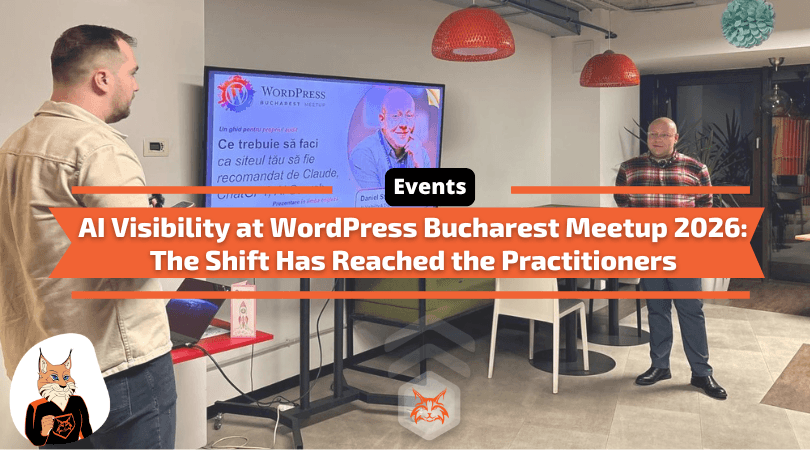
The Bucharest WordPress Meetup on October 15, 2026, was the fourth test. This time, the room wasn’t full of industry leaders or executives but about 50 people who build and run websites day to day: WordPress site owners, bloggers, freelancers, small agencies, and developers.
My question was: has the AI shift reached the people who actually maintain sites in a local market? The answer is yes, as they have already felt it. Nobody needed convincing that something had changed. But from their questions, I understood they wanted a checklist they could run themselves to improve their visibility in AI search.
Romanian Buyers Are Already Asking AI
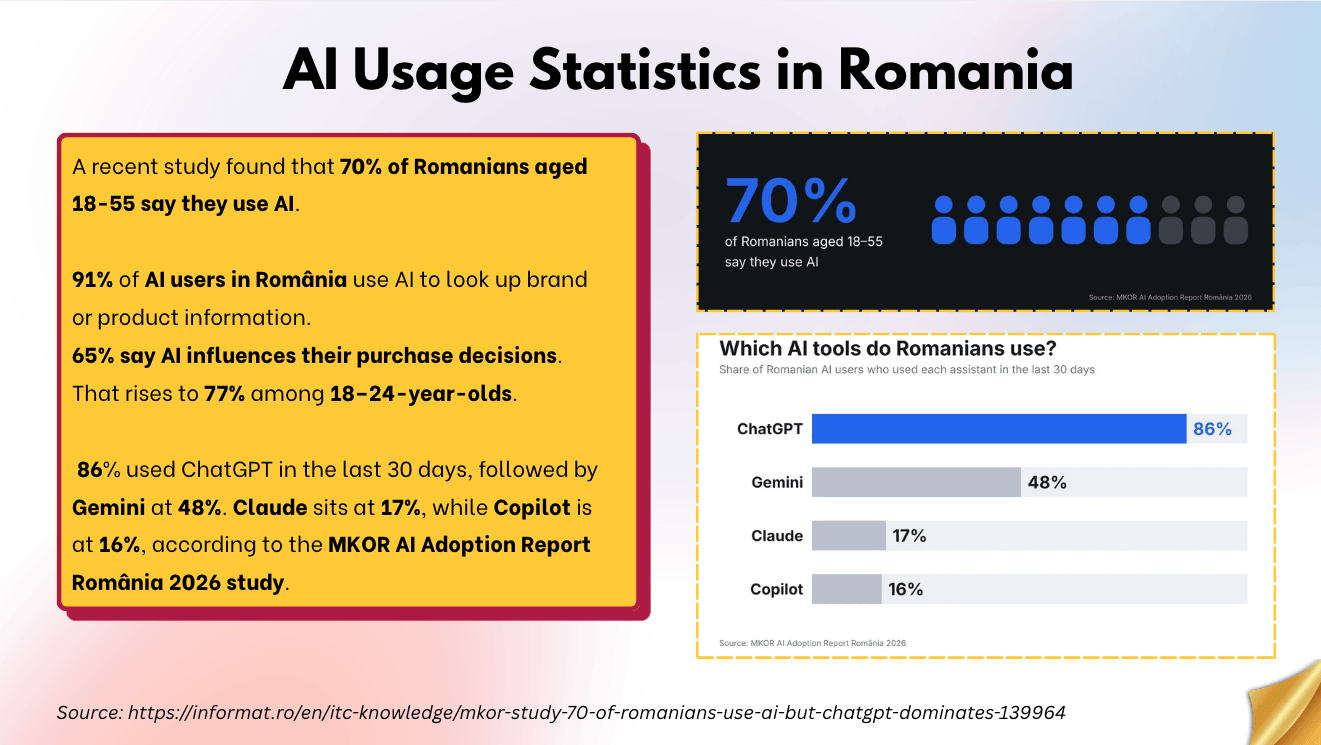
Most AI Visibility conversations rely on US data. For a Romanian audience, I used local numbers from the MKOR AI Adoption Report România 2026:
- 70% of Romanians aged 18–55 say they use AI.
- 91% of AI users in Romania use it to look up brand or product information.
- 65% say AI influences their purchase decisions, rising to 77% among 18–24-year-olds.
- 86% used ChatGPT in the last 30 days, followed by Gemini at 48%, Claude at 17%, and Copilot at 16%.
For a Romanian business, this means AI is not a future channel. It is already part of how local customers research before they buy, and in Romania that research happens mostly in ChatGPT and Google.
Who Survived the Great Blogging Collapse
I opened with data from the Great Blogging Collapse study, which follows 100 content sites earning $5,000+ a month, across 8 niches, from 2022 to 2026. 64% lost more than half their organic traffic, with a median loss of 85%. Google core updates and AI Overviews drove most of it.
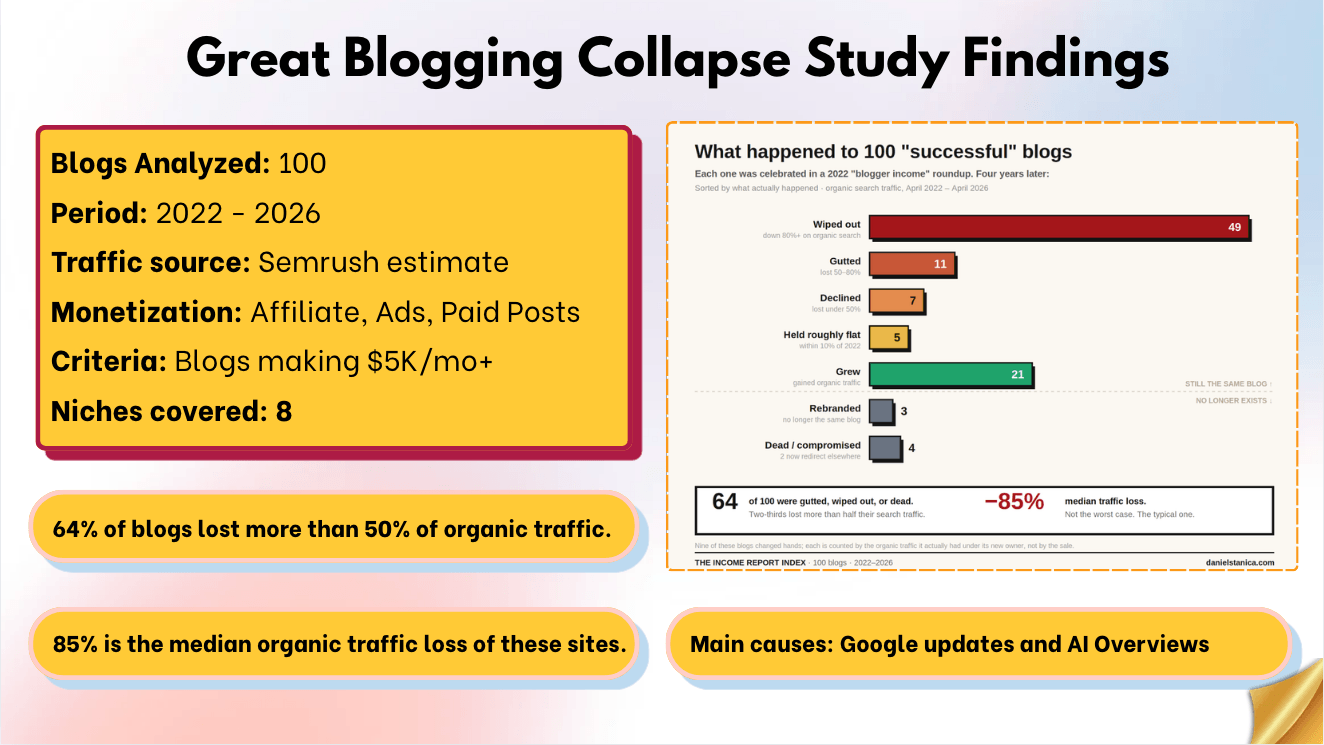
The more useful finding is about the 21 sites that held or grew their traffic. They shared four traits:
- First-hand experience in their content.
- An established brand people search for by name.
- An owned audience, such as email or a community.
- Real products, not just content.
None of these is a classic on-page SEO factor. All four signal that a real business stands behind the website, and AI systems lean on those signals when deciding whom to mention.
SEO and AI Visibility Are Two Different Games
AI Overviews now appear on roughly 43–50% of US queries (SimilarWeb and Semrush, July 2026), and about 68% of Google searches end without a click (SparkToro, June 2026). Ranking still matters, but it no longer guarantees a visit.
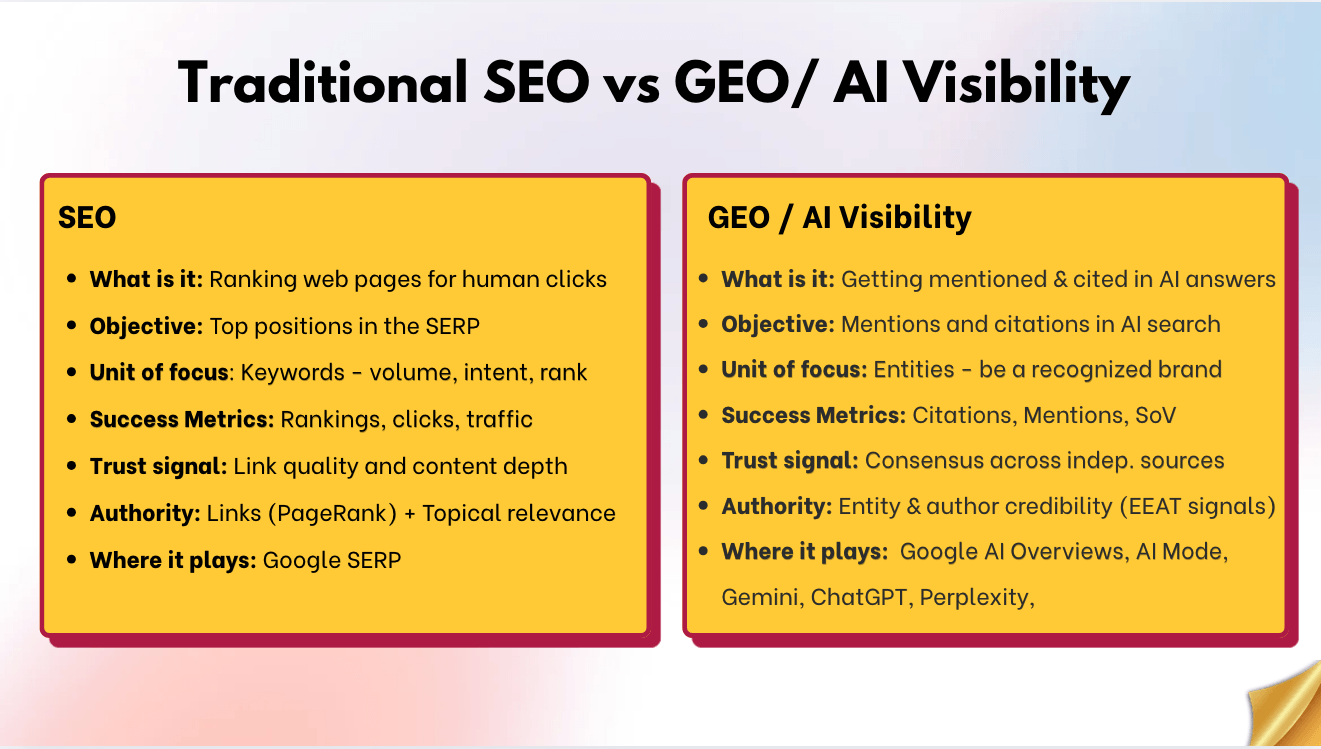
I spent the most time on the trust signal. In SEO, authority comes largely from links. In AI Visibility, it comes from agreement across independent sources: many sites with no stake in you describing your brand in the same way. A strong page that nobody else talks about rarely gets recommended.
The AI Visibility Framework
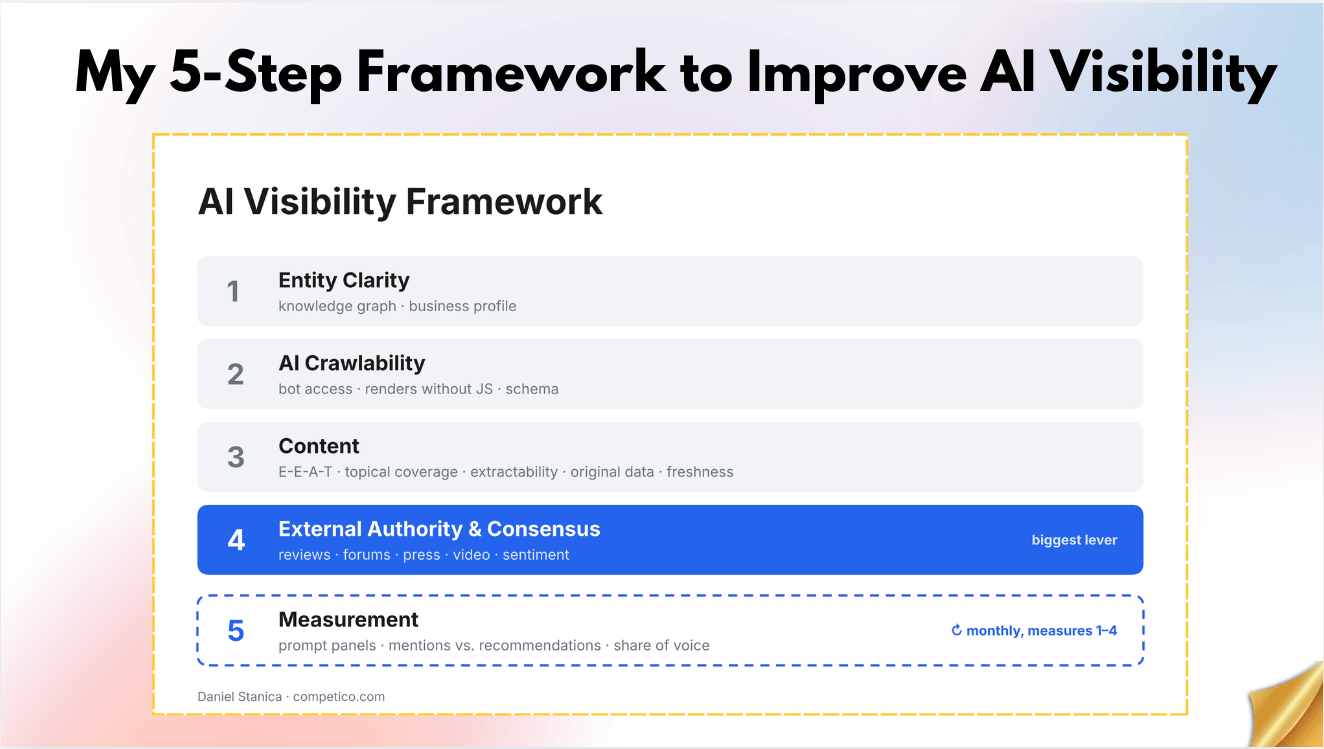
The core of the talk was the five-pillar framework we use at Competico with clients:
- Entity clarity. Make sure AI knows exactly who you are: a consistent name, description, and category everywhere, with Organization and Person schema and a Wikidata entry.
- Technical access. Let AI crawlers reach your content, and serve key facts as plain, fast-loading HTML.
- Content AI can extract and trust. Cover sub-questions in depth, show real experience, publish original data, keep pages fresh, use precise and dated claims, and structure each section so it makes sense on its own.
- External authority and consensus. Earn mentions where AI looks: YouTube, Reddit, industry press, and review platforms.
- Measurement. Track a repeated prompt panel, branded search, direct and AI referral traffic, and what customers say when you ask how they found you.
The full breakdown of each pillar is in my personal recap.
WordPress Is Both the Risk and the Fix
The most practical moment of the evening was realizing how many AI Visibility problems on WordPress come from default settings, not strategy. Security plugins and CDN rules can block AI crawlers without the site owner knowing. Sliders, tabs, and page-builder widgets can hide content from bots that don’t run JavaScript.
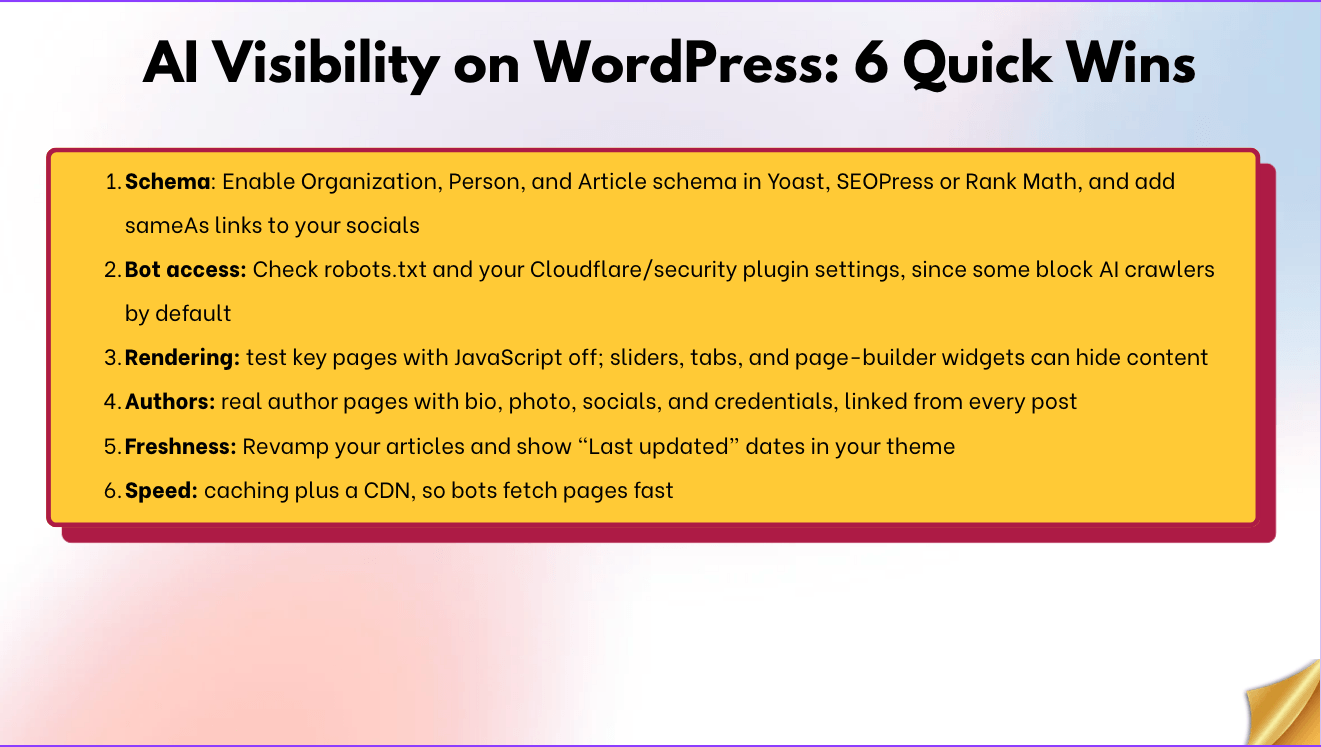
The flip side is that many fixes are already within reach. The SEO plugins most people run (Yoast, SEOPress, Rank Math) can output Organization, Person, and Article schema. Author pages, “last updated” dates, and caching with a CDN are standard WordPress features. A small site can close several of the most important gaps in an afternoon, without hiring anyone.
What Bucharest Confirmed
Kraków, Budapest, Atlas and Bucharest were four very different rooms. Bucharest added three conclusions:
The AI Visibility shift has reached the grassroots.
It is no longer only a topic for executives and conference stages. Local site owners and freelancers have felt it in their own analytics and their clients’ questions.
Small businesses need a checklist, not a strategy deck.
Enterprise teams ask about operating models and budgets. A room of WordPress practitioners asks what to change in their plugins this week. Both are right for their context, and AI Visibility has to be packaged for both.
The local market is still early.
Romanian buyers are already asking AI about brands and products, but few Romanian businesses check what AI says about them. That gap is the opportunity, and as in every other room this year, it will not stay open for long.
Conclusion
If you run a business in Romania, or anywhere else, and your traffic is falling while AI tools recommend your competitors, that is exactly the problem we solve at Competico. Let’s talk in a non-binding 30-minute consultation.
Thanks to Lumi Ciobanu, Eduard Doloc, and Alex Spataru for organizing; to ImpactHub for hosting; to Uprise.ro for sponsoring; and to everyone who came and asked such good questions.